
Plate & Shell Heat Exchangers (PSHE) in Oil & Gas: An Introduction
This article explores key challenges in the Oil & Gas industry and explains why reliability, safety and low maintenance are essential when selecting heat exchangers. It also highlights the leading role of Plate & Shell Heat Exchanger (PSHE) technology in addressing these challenges.
The Role of Heat Exchangers in The Oil & Gas Industry
Heat exchangers play a critical role in Oil & Gas facilities, even though they are not among the most visible pieces of equipment. They are used across crude processing, gas treatment and utility systems. In principle, their function is simple: heat naturally transfers when a hot medium comes into contact with a colder one, as described by basic thermodynamics.
In practice, however, this becomes much more challenging. Issues such as fouling, corrosion and erosion must be managed. It is also essential to maintain strong boundaries to prevent the mixing of media, while designers must address technical and commercial constraints related to size, weight and cost. Together, these factors quickly turn a simple concept into a complex engineering challenge.
A good heat exchanger is compact and lightweight, resists fouling during operation and is easy to clean and maintain when needed. It must operate safely, both for the process and the surrounding environment, while delivering reliable heat transfer over a long service life. Ideally, it also remains cost-efficient.
In the Oil & Gas industry, reliability, safety and low maintenance are the most important factors. Failures in these areas can be extremely costly. For this reason, engineers and operators prioritise proven designs that perform safely and predictably over time. Plate & Shell Heat Exchangers (PSHE) have earned their place by consistently delivering this level of dependable performance in real-world applications.
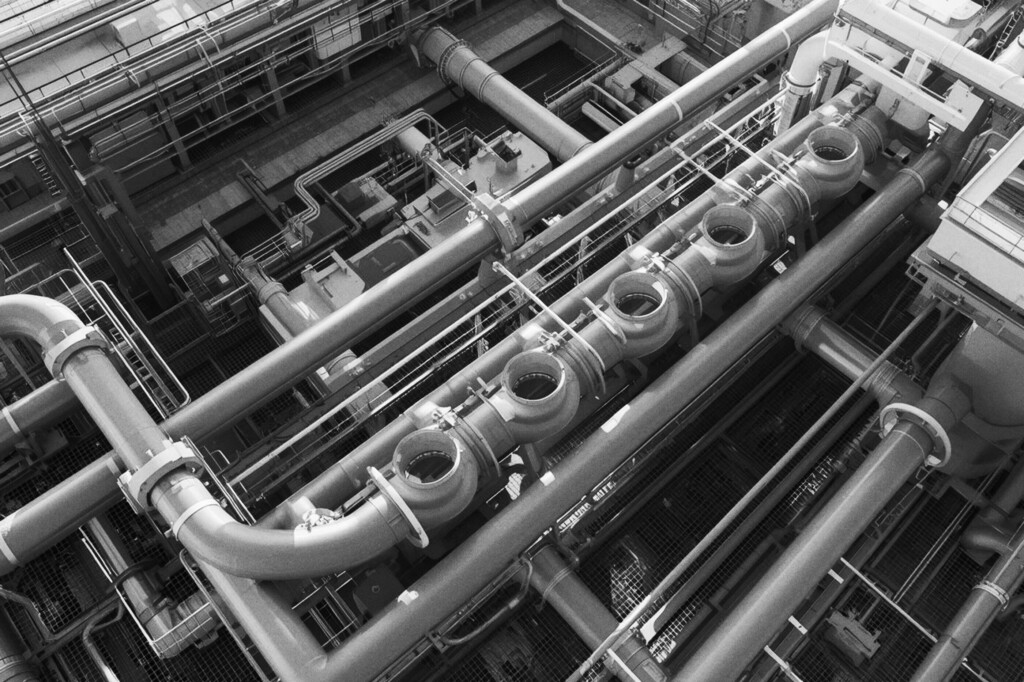
Process piping and equipment in an Oil & Gas installation, highlighting the complex operating conditions and the need for reliable, safe and low-maintenance heat exchanger solutions.
Plate & Shell Heat Exchanger Reliability in Oil & Gas: Gasket‑Free, Fully Welded Design
Plate & Shell Heat Exchangers (PSHE) deliver high reliability in Oil & Gas through a fully welded, gasket-free design that reduces failure points and enables long, continuous operation.
PSHE was developed to combine the strengths of two well-known concepts. From traditional gasketed plate designs, it takes high thermal efficiency, strong shear forces that reduce fouling, close temperature approaches and a compact footprint. From the Shell & Tube technology, it gains mechanical strength, high pressure and thermal stress resistance, and full environmental containment. This is achieved by welding the heat transfer plates into a single plate pack and enclosing it inside a pressure-rated shell. As a result, the design avoids the usual trade-offs between efficiency, strength and maintenance.
The outcome is a gasket-free solution that operates far beyond the pressure and temperature limits of conventional plate units. Its compact design and high efficiency are retained, making PSHE well-suited to the pressures, temperatures and fluids found across the Oil & Gas value chain, from extraction to processing.
A key reason for the widespread acceptance of Plate & Shell technology is its operational reliability. The fully welded construction removes the most common source of leaks in conventional plate designs, reducing failure points and enabling longer, continuous operation.
Safe Operation in Oil & Gas: Fully Welded Plate & Shell Heat Exchangers
Plate & Shell Heat Exchangers (PSHE) provide safe operation in Oil & Gas through a fully welded design that ensures complete containment of process media.
A fully welded barrier between the media, combined with a pressure-rated shell, prevents leakage and eliminates cross-contamination. The design can be built to sour and even lethal service standards, in line with established industry codes. This gives designers and operators confidence when handling hydrocarbons and other hazardous media.
Without internal gaskets, there are no components that can degrade due to pressure changes, thermal cycling or chemical exposure. This allows the use of high-grade alloys that remain compatible with the process media over the long term, supporting safe and stable operation.
Even in the unlikely event of a failure within the plate pack, any leak is contained inside the thick, pressure-bearing steel shell. Process monitoring systems alert operators to the issue, while personnel on site and the surrounding environment remain protected, even under demanding operating conditions.
Engineered for Low Maintenance: Plate & Shell Heat Exchangers in Oil & Gas
Plate & Shell Heat Exchangers (PSHE) reduce maintenance requirements in Oil & Gas through an inherently low-fouling design that minimises downtime and service needs.
High shear stresses inside the exchanger create an inherent anti-fouling effect, slowing the loss of heat transfer efficiency over time and reducing the need for maintenance. The absence of internal gaskets further minimises downtime and lowers lifetime operating costs. When cleaning is required, chemical backflushing is typically sufficient to resolve most fouling issues.
If mechanical cleaning is needed, PSHE can be designed with an openable body flange. This allows the internal plate pack to be removed for full external access, similar to removing a tube bundle from a Shell & Tube unit. However, unlike traditional designs, PSHE require significantly less maintenance space. This delivers a double benefit: a more compact unit and reduced space requirements within the overall platform or plant layout.
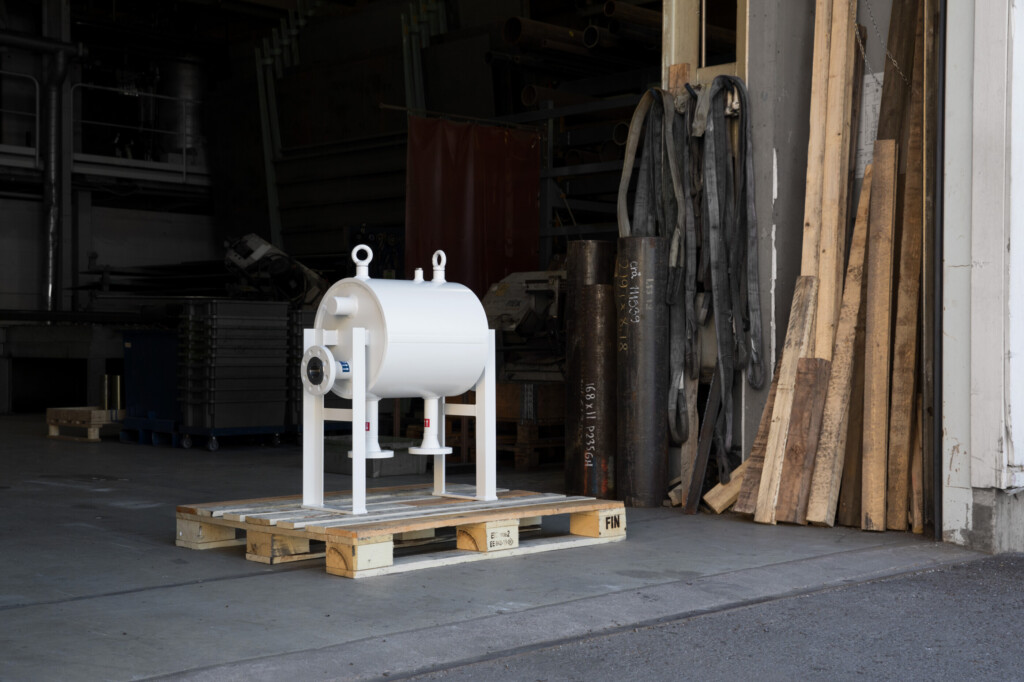
A Vahterus Plate & Shell Heat Exchanger (PSHE) in one of our factories in Kalanti, Finland.
Plate & Shell Heat Exchangers (PSHE) offer many advantages, but no single technology suits every application. Traditional gasketed plate heat exchangers, Shell & Tube units, spiral heat exchangers and others all continue to have their place. That said, the unique strengths of PSHE make them well-suited to critical applications, including:
- FPSO
- Gas treatment
- Crude oil treatment
- Gas distribution
- LNG terminals
- Refineries
- Petrochemicals
In these demanding environments, where reliability, safety and low maintenance are essential, PSHE technology provides a dependable solution.
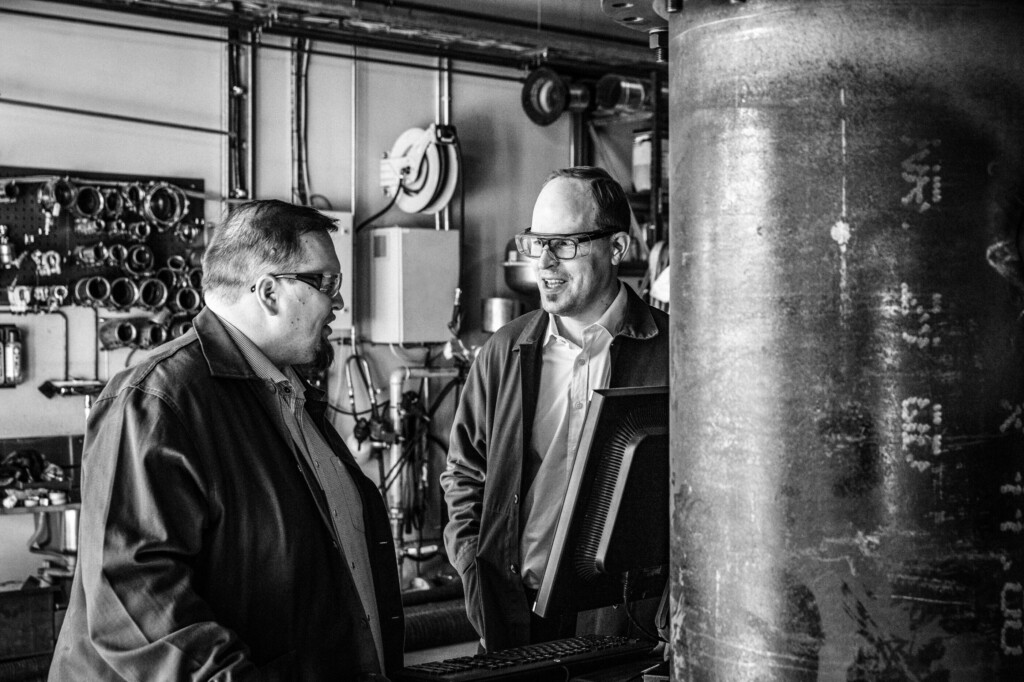
Oil & Gas industry experts Lauri Bastman (Global Key Account Manager at Vahterus) and Frans Launonen (Sales Director, Energy Business at Vahterus).
Interested to Learn More?
Vahterus Plate & Shell Heat Exchangers consistently meet and exceed industry standards, delivering reliable performance in challenging industrial settings such as Oil & Gas, where safety is a core design requirement rather than an afterthought.
To learn more about our PSHE solutions, please get in touch below.