
Expert Q&A: An Outlook on Industrial Heat Pump Development
Vahterus welcomed over 200 attendees from across the globe to Turku, Finland, on 16–17 June 2026 for its biennial Heat Pump Forum, where discussions focused on the future of industrial heat pumps and natural refrigeration technologies. To provide a broader outlook on heat pump development, we spoke with forum speakers and industry experts Martin Stage Pihl Andersen (DTI) and Antti Uusitalo (Lappeenranta University) in the below Q&A.
What is currently holding the scale-up of industrial heat pumps back – and how is the industry addressing these challenges?
Martin Stage Pihl Andersen: A few years ago, the main limitation would have been the technology itself. That is no longer the case. Today, high-temperature heat pumps are already operating across multiple industries, reaching temperatures of up to 200°C. The key challenge now is building confidence in heat pump-based systems, particularly as applications often require tailored integrations. Unlike standardised solutions, industrial heat pump projects are highly specific, which can create uncertainty around the business case and slow down wider adoption. The industry is addressing this by actively sharing proven use cases and real-world results, helping to demonstrate reliability and long-term value. While this has increased awareness and trust, there is still an opportunity to communicate these successes beyond the existing network and reach a broader audience.
Antti Uusitalo: Industrial heat pump technology is already proven, with operating systems across sectors such as chemical, food and beverage and pulp and paper, as well as in district heating – particularly in the Nordic countries. These applications clearly demonstrate the potential for both emission reductions and cost savings. The main challenge now lies in improving integration, control and overall cost-effectiveness, especially in regions where energy price dynamics weaken the business case. In parallel, limited awareness within industry and a shortage of experienced specialists are slowing wider adoption. To address this, the industry is increasingly focusing on knowledge sharing between technology providers and end users. Supportive policy frameworks can also play an important role in accelerating implementation, particularly in markets where economic conditions are less favourable. Alongside this, continued development of expertise and stronger industrial process integration will be key to scaling deployment.
Where are heat pumps already delivering real industrial value in the green transition today?
Martin Stage Pihl Andersen: Industrial heat pumps are already delivering strong value in sectors such as district heating and food and beverage. Water-based systems at utility-level are seen as the most mature, which is driving adoption in applications like dairies and breweries.
Antti Uusitalo: Industrial heat pumps are already delivering measurable value across energy-intensive industries and in district heating, where the technology is well proven. These applications demonstrate clear benefits in both reduced energy costs and lower emissions. A key advantage is the ability to recover and upgrade low-grade waste heat from industrial processes, feeding it back into operations and improving overall efficiency. This can significantly reduce energy demand and operating costs. Beyond individual sites, heat pumps also strengthen energy security by enabling the use of local heat sources, reducing reliance on imported energy. When powered by renewable electricity, they play a direct role in supporting the green transition.
What will define the next phase of heat pump development?
Martin Stage Pihl Andersen: The next phase will be shaped by how effectively heat pumps can deliver steam and utilise available excess heat. This requires more integrated project approaches, as solutions are highly application-specific and often extend beyond standard equipment delivery. Going forward, closer collaboration with EPC partners – or a broader project scope taken on by technology providers – will be key to scaling deployment.
Antti Uusitalo: Recent development has strongly focused on systems using natural refrigerants – such as CO₂, Ammonia, and Hydrocarbons – alongside achieving higher supply temperatures while maintaining a high COP. This has opened up new application areas for industrial heat pump integration. Heat pumps are already well established in district heating and in producing hot water for industrial processes. The next phase will see increasing adoption of steam-generating heat pumps, enabling the replacement of fossil fuel and combustion-based steam across a wider range of industries. While the technology itself is largely mature and core solutions are already available, the focus is now on improving cost-effectiveness and strengthening integration into industrial processes. Continued progress in these areas, combined with the use of natural refrigerants and further increases in supply temperatures, will define the next stage of development.
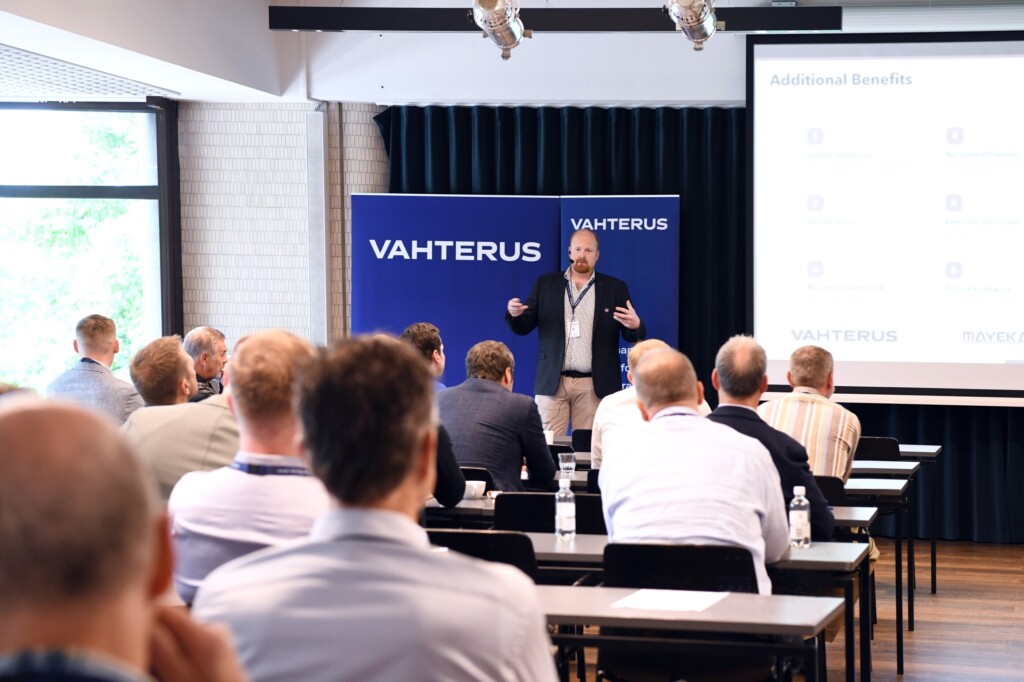
Vahterus hosted its biennial Heat Pump Forum in Turku, Finland, on 16–17 June 2026.